What Is the Average Reaction Time?
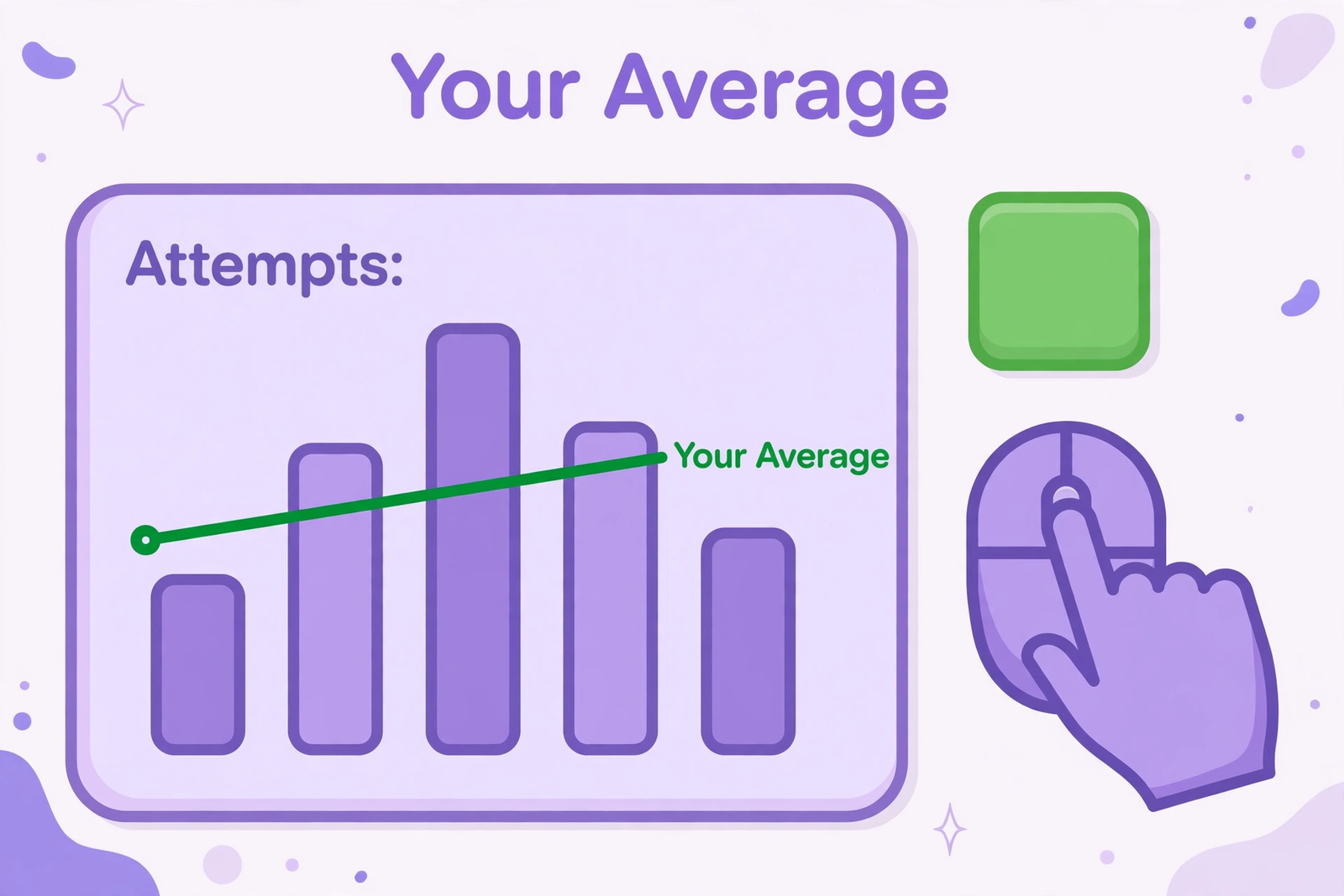
Table of Contents
- What an Average Actually Means
- The Mean of Your Valid Tries
- Why One Try Is Not an Average
- What the Spread Adds to the Mean
- A Group Average Is a Different Number
- Why Averages Move Between Tests and Days
- Different Tests Measure Different Tasks
- Devices and Input Delay Change the Reading
- Conditions Around You Matter Too
- Variation Across Days Is Normal
- Comparing Your Own Average Fairly
- Keep the Test and Setup the Same
- Read Clusters, Not Single Jumps
- Outliers and How to Handle Them
- Using Your Average as a Personal Reference
- A Simple Record That Lasts
- When the Mean Alone Stops Helping
- What an Average Cannot Tell You
- Frequently Asked Questions
- Why is my average reaction time different on another website's test?
- Should I use my fastest try or my average reaction time for comparison?
- How do I know if my average reaction time is improving over time?
- Why does one slow try change my average reaction time so much?
- What notes should I keep beside each average reaction time result?
Many readers see an average quoted online and wonder whether that number should match their own result. The confusion grows because some averages describe one round, while others describe a whole group. Mixing those two meanings can make a normal personal result feel surprisingly fast or slow.
This guide explains your average as the mean of your valid tries under similar testing conditions. You will learn how the mean is worked out, what the spread shows, and how to track consistency. By the end, you can read your result as a personal reference, not as a confusing universal standard.
What an Average Actually Means
The Mean of Your Valid Tries
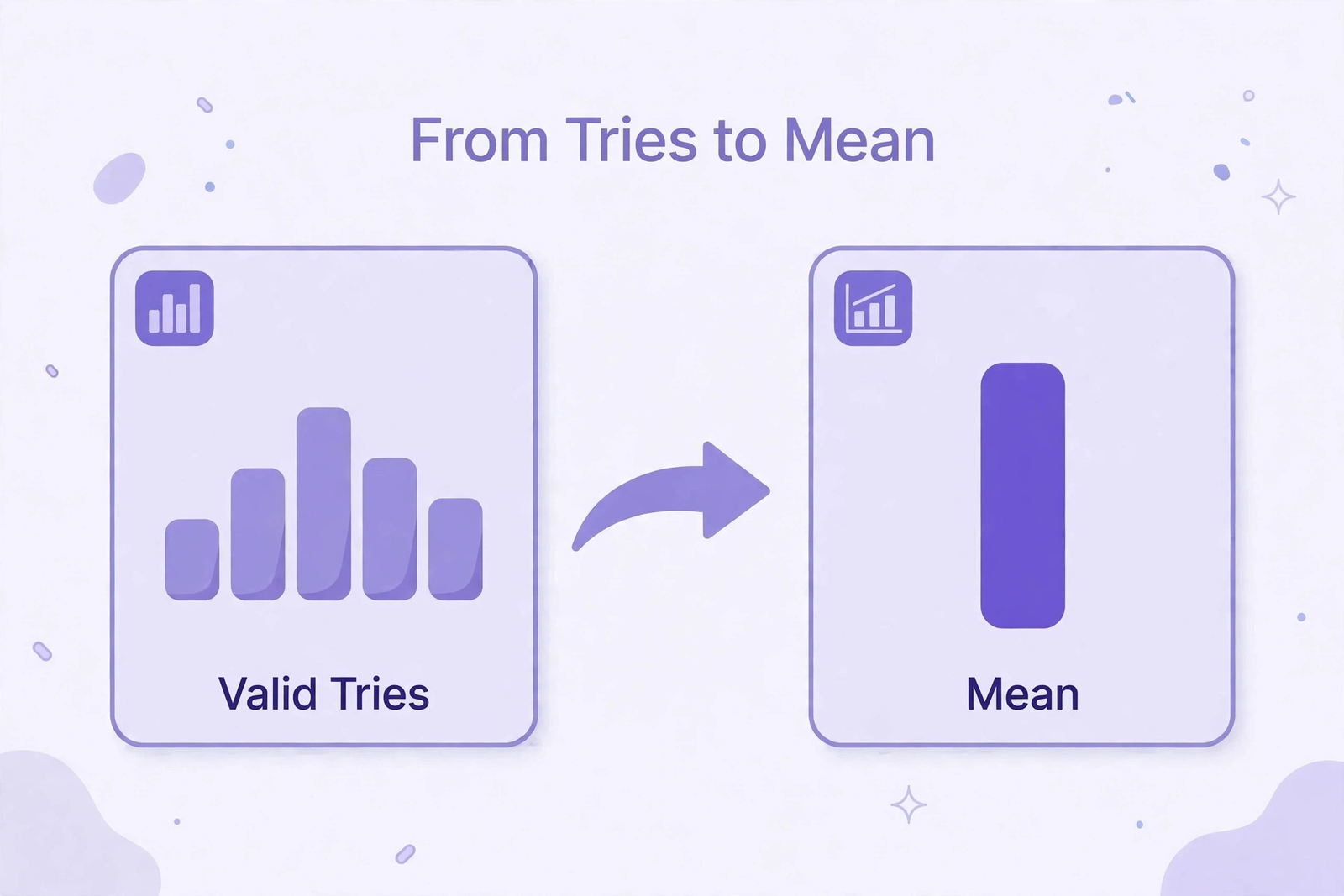
In a five-try round, each valid result contributes equally to the final mean for that round. A faster try pulls the mean slightly lower, while a slower try pulls it slightly higher. No single try is ignored, and no single try decides the final result entirely on its own.
Too-soon clicks do not enter the calculation, because they are not valid responses to the signal. The test waits until five valid responses have been recorded before showing a mean. That rule keeps the mean honest, since early guessing cannot distort the final number.
Many guides report average reaction time in ms because milliseconds give a fine unit for small gaps. The mean still describes one round, rather than a fixed speed that applies on every day. Some tries will be faster, and some will be slower, and the mean sits between them.
Why One Try Is Not an Average
A single try captures one moment, with one level of focus and one set of conditions. That try might have benefited from perfect focus, or suffered from a brief distraction. Either way, it cannot show your typical speed across a full round of valid tries.
Do not judge a whole round from its fastest try, because the fastest try is unusual by definition. Likewise, do not judge a round from its slowest try, which may reflect one lapse alone. The mean across five tries gives a fairer summary than either extreme on its own.
If one result surprises you, look at the other tries in the same round first. A surprising try surrounded by steady tries probably reflects a momentary factor, not a trend. Wait for several rounds before drawing any conclusion about change over time.
What the Spread Adds to the Mean
A mean can hide wide differences between tries, because it blends fast and slow results together. Two rounds with the same mean might contain very different patterns of individual tries. One round could be steady, while another swings sharply from fast to slow.
Looking at individual tries beside the mean reveals whether a round felt steady or scattered. A steady round suggests sustained attention across all five valid tries in that session. A scattered round suggests that focus, distraction, or device issues affected some tries more.
The mean remains useful as a summary, but it works best alongside that fuller picture. Note the spread of tries as well as the mean, so one number never misleads you. Together, mean and spread describe a round far more honestly than either alone.
A Group Average Is a Different Number
A figure labelled average human reaction time usually describes a group, not your own round. Group figures blend many people, devices, and tests into one broad summary number. That broad number cannot tell you whether your own round was steady or scattered.
Comparing yourself with a group figure often creates needless worry about a normal result. Your device, test design, and setting may differ sharply from the group behind that figure. Use group figures only as background, and judge your own rounds against your own history.
Your own mean answers a narrower question, namely how you responded on that test that day. That narrower answer is more useful for tracking change than any broad group figure. Keep the two ideas separate, and the confusion around averages largely disappears.
Why Averages Move Between Tests and Days
Different Tests Measure Different Tasks
Different tests use different signals and tasks, so their results naturally vary from each other. One test may use a visual signal, while another may use a sound or a different task. The steps involved, the device used, and the instructions given can all change the result.
The way a test counts a response also affects the mean that it finally produces. Some tests include many tries, while others rely on only a few tries for the result. Some tests allow practice rounds, while others start measuring from the very first attempt.
For that reason, comparing a mean from one test with a mean from another test can mislead you. A lower number on one test does not necessarily mean faster responses in any general sense. It may simply reflect an easier task, a different signal, or a different counting method.
Devices and Input Delay Change the Reading
The device you use can influence how quickly a click or tap gets recorded by the test. A mouse, a touchscreen, and a trackpad do not all register input in exactly the same way. Screen refresh rates and input delay can also add small differences to the measured time.
Response speed therefore includes both your own movement and the delay of your setup. A new mouse or a different screen can shift the mean even when your focus stays the same. That shift describes the setup, not a sudden change in your underlying response speed.
Keep the same device whenever you want rounds to stay comparable across sessions. Note any device change beside the mean, so a later shift has a clear explanation. Without that note, you may mistake a setup change for a change in response speed.
Conditions Around You Matter Too
Your surroundings and state of mind can shift the result just as much as the device. Distractions in the room, tiredness after a long day, or lost focus can slow a try. A calm, quiet setting with steady attention usually produces a more consistent set of tries.
Even the time of day and your recent activity can play a role in a round. You may feel sharper after rest and slower after long screen use or poor sleep. None of this means the test is broken, because it simply captures a moment in time.
Testing conditions therefore belong beside every mean you record, not as an afterthought. Those notes turn a puzzling shift into a plain story about setting, rest, or focus.
Variation Across Days Is Normal
Rounds completed on different days can differ because sleep, mood, and surroundings change daily. A morning round after rest may feel sharper than an evening round after long screen use. Those daily changes are normal, and they do not mean your basic speed has shifted suddenly.
Expect a range of means across rounds, rather than one identical value every time. A range shows honest variation, while identical means every round would look suspiciously neat. Variation itself is information, because it shows how conditions shape each round.
Do not chase identical means, because human attention rarely stays exactly the same daily. Judge your rounds by their usual range, not by whether one round matches another exactly.
Comparing Your Own Average Fairly
Keep the Test and Setup the Same
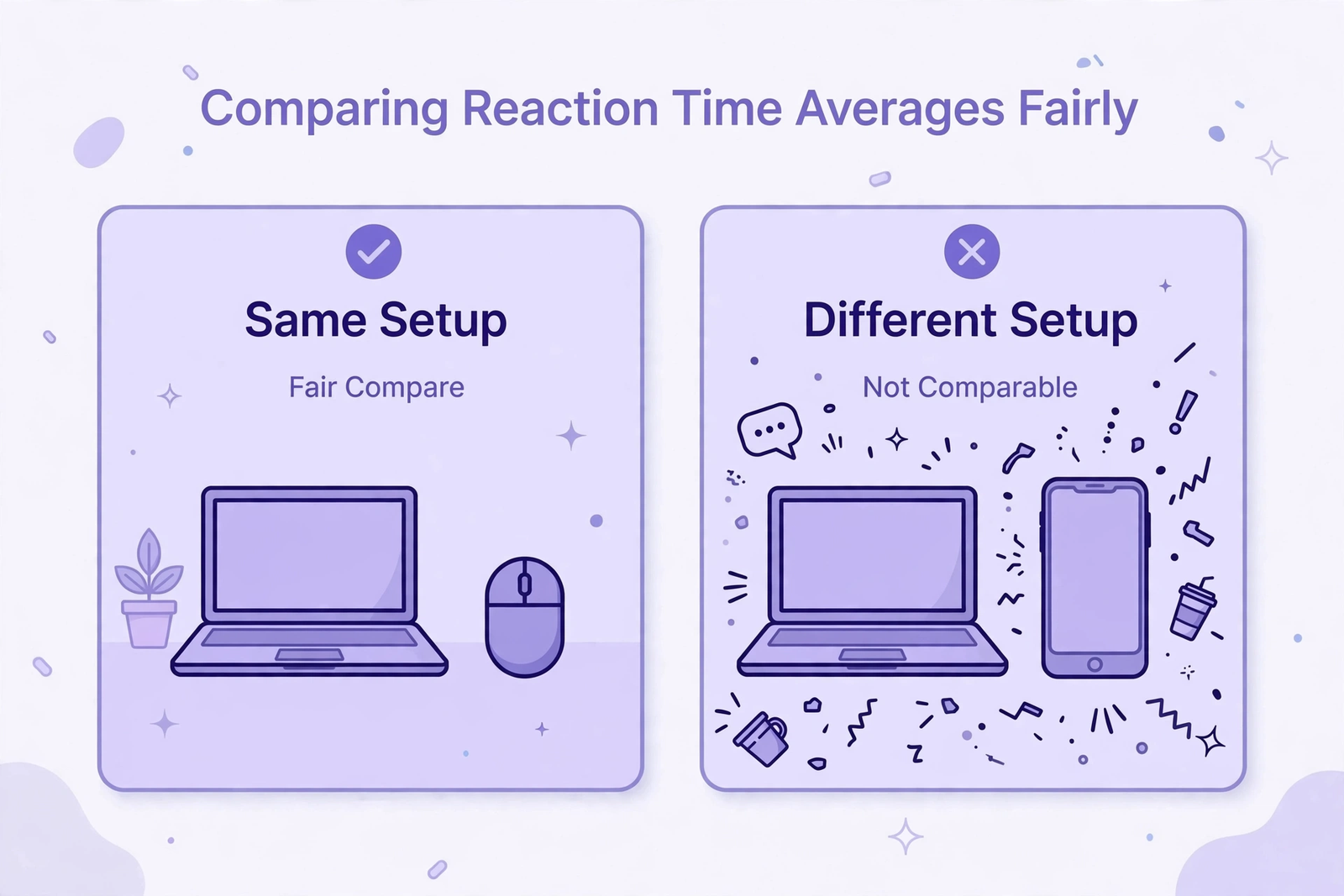
Comparing your own mean on the same test gives the fairest picture of your typical speed. The test design stays the same, so changes are more likely to reflect focus or conditions. You can repeat the visual test under similar conditions and watch for patterns across rounds.
Your own history also protects you from misleading comparisons with other people or tests. Other people may use different devices, tests, or settings that you cannot see. Their results may look faster or slower for reasons that have nothing to do with ability.
Fair comparison begins with using the same visual test for every round you compare. Use the same device, setting, and hand position whenever you want rounds to stay comparable. Keep the room quiet, the screen distance steady, and distractions as low as possible each time.
Read Clusters, Not Single Jumps
Keep a simple record of each round, including the mean and the conditions around it. Over several days, that record shows whether most rounds cluster near a similar range. A cluster tells you more than any single day, because it smooths out daily ups and downs.
When you compare days, look for a gradual pattern rather than one sharp jump between rounds. A gradual shift may prompt you to check sleep, rest, or device changes first. A single jump that disappears the next day probably reflects a momentary distraction instead.
A steady set of rounds near one range suggests a stable typical range for your setup. A slow drift away from that cluster may deserve a closer look at conditions first.
Outliers and How to Handle Them
An outlier is a single try that sits far from the other tries in a round. Because the mean includes every valid try equally, one outlier can pull it noticeably. A very slow try raises the mean, while a very fast try lowers it slightly.
With only five tries, each try carries real weight in the final mean calculation. That weight explains why a mean can shift even when most tries stayed steady. Four steady tries plus one extreme try will still produce a shifted mean.
Outliers do not make a round invalid, because they reflect genuine moments during the test. They do mean the mean should be read alongside the individual tries, not alone. Checking the spread helps you see whether an outlier or a general shift caused the change.
Using Your Average as a Personal Reference
A Simple Record That Lasts
A simple record can be a notebook, a note on your phone, or a basic spreadsheet. For each round, write the date, the mean, and a brief note about conditions. Keep the format identical every time, so later entries remain easy to compare fairly.
Add a short note about focus, device, and setting, without turning record-keeping into a chore. Three brief notes per round are enough to explain most later shifts in means. Over weeks, your notes reveal a typical reaction time range for your current setup and habits.
Review your record after every few rounds, rather than after every single round alone. A short review reveals clusters, outliers, and possible condition changes at a glance. That rhythm keeps tracking useful without making each round feel like a judgement.
When the Mean Alone Stops Helping
An average stops being useful alone when conditions change sharply between the rounds compared. A new device, a different test, or a noisy setting can shift the mean unfairly. In those cases, the mean describes the new setup as much as your response speed.
An average also loses meaning when tries scatter so widely that no typical value emerges. If tries range from very fast to very slow, the mean sits between extremes unhelpfully. The spread then matters more, because it shows attention or setup problems during that round.
When the mean alone feels unclear, return to the individual tries and your condition notes. Those details often explain the mean better than the number itself can. Use the mean as one tool among several, not as the only verdict on a round.
What an Average Cannot Tell You
Your mean cannot tell you how you compare with other people in any broad sense. It cannot diagnose a health condition, and it cannot measure your broader abilities or potential. It also cannot capture factors like sleep, stress, or device differences in one number.
The most useful comparison is with your own earlier rounds on the same test. Repeating the visual test under similar conditions gives a clearer sense of change over time. A small shift between rounds may simply reflect focus, timing, or device setup that day.
Treat your mean as a personal benchmark for your own rounds, not as a universal cutoff. That boundary keeps the number honest and prevents unfair conclusions about yourself or others. A clear boundary around the mean actually makes it more useful, not less.
Frequently Asked Questions
Why is my average reaction time different on another website's test?
Different websites use different signals, tasks, devices, and counting methods for their tests. Those design differences can shift a mean even when your response feels exactly the same. Compare means only from the same test, because cross-test numbers describe different tasks.
Should I use my fastest try or my average reaction time for comparison?
Use your mean for comparison, because it summarises all five valid tries fairly. Your fastest try shows one moment only, and it may not repeat in the next round. The mean plus the spread of tries gives a steadier basis for tracking change.
How do I know if my average reaction time is improving over time?
Look for a gradual shift in means across several rounds under similar conditions. A cluster of recent means sitting near a new range suggests a pattern worth noticing. A single fast round alone does not prove improvement, because it may reflect one lucky moment.
Why does one slow try change my average reaction time so much?
With only five tries, each valid try carries real weight in the final mean calculation. One very slow try therefore pulls the mean upward more than it would in a larger set. Check the individual tries beside the mean to see whether one outlier caused the shift.
What notes should I keep beside each average reaction time result?
Record the date, the mean, and brief notes about device, setting, and focus for each round. Those notes explain later shifts that might otherwise look like changes in response speed. Keep the format simple and identical, so your record stays easy to review over weeks.
Your own average becomes most useful when you treat it as a tool for noticing change. Repeat the same visual test, keep your setup similar, and record your mean for each round. Over time, you will build a picture of your usual range and your natural variation.